How to Protect Your Deal If Your Florida Home Appraises Low
Quick answer: When a Florida home appraises below your contract price, you're facing an appraisal gap. Your choices are to renegotiate the price, ask for seller credits, split the difference, adjust how much cash you bring in, or appeal the appraisal. The right move depends on your numbers, the strength of the appraisal, and how motivated both sides are to close.
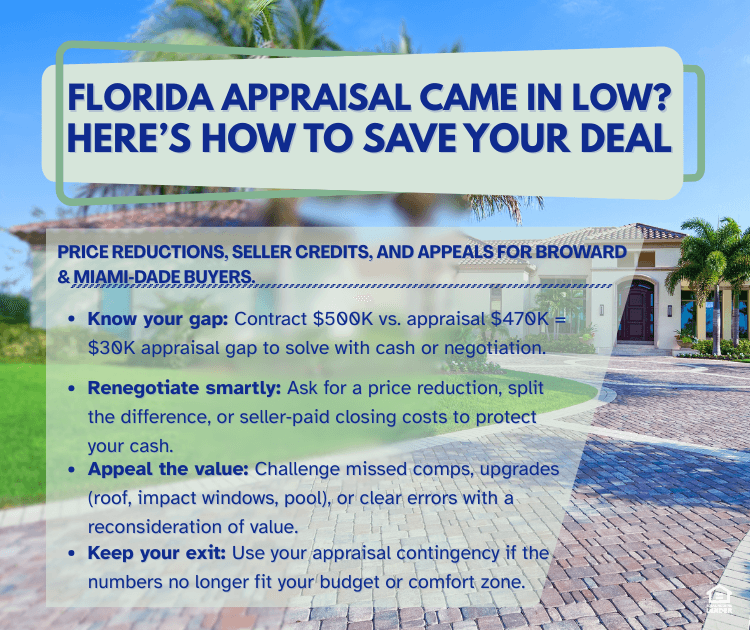
Few moments in a Florida home purchase cause more stress than a low appraisal. But with the right strategy, you can protect your deal, and your peace of mind.
Why Florida Appraisals Come In Low
In fast-moving markets like Miramar, Pembroke Pines, Hollywood, Weston, and across Broward, Miami-Dade, and Palm Beach, it's common for appraisals to trail behind offer prices. If you're competing with cash offers in competitive markets, understanding appraisal dynamics is critical.
A low appraisal often happens because:
Recent sales ("comps") lag the market. Prices may have climbed since comparable homes closed.
The appraiser used older, weaker, or less similar comps.
The property has upgrades (impact windows, new roof, pool, remodeled kitchen) that don't show up in the valuation.
Multiple offers pushed the price higher than recent closed data can support.
A low appraisal doesn't always mean you overpaid. It means the appraiser couldn't justify the price using available data.
Understand the Appraisal Gap
The appraisal gap is the difference between your contract price and the appraised value:
Contract price: $500,000
Appraised value: $470,000
Appraisal gap: $30,000
Your lender bases the loan on $470,000, not $500,000. That gap must be resolved with cash, negotiation, or both.
Negotiation Options When the Appraisal Is Low
Here's a quick decision guide:
Price reduction: Best when the appraisal looks accurate and the seller is motivated.
Split the difference: Best when both sides want to compromise and close.
Seller credits: Best when you need to preserve cash and the seller wants to protect the headline price.
Appeal: Best when the appraisal clearly missed better comps or contains errors.
Walk away: Best when the numbers no longer make sense.
Option 1: Ask for a Price Reduction
Ask the seller to reduce the price from $500,000 to $470,000 so the contract matches the appraisal. You still bring your planned down payment percentage, just on the lower price.
Option 2: Split the Difference
If the seller won't drop to the appraised value, suggest splitting the gap. The seller drops the price by $15,000, and you bring $15,000 more in cash.
Option 3: Negotiate Seller Credits
Some sellers will protect the headline price but offer seller-paid closing costs or credits for repairs. This reduces your upfront cash while keeping the contract price higher.
If you're unsure how a low appraisal could affect your loan, reach out—we'll walk you through your options before you make any decisions.
Appraisal Gap Strategies You Can Plan in Advance
In competitive parts of Broward, Miami-Dade, and Palm Beach, buyers sometimes include an appraisal gap clause in the offer. Learn more about how to compete against cash offers.
"Buyer agrees to pay up to $10,000 above appraised value if the appraisal comes in low."
This can make your financed offer more attractive and show the seller you're serious—but it only makes sense if you truly have the extra cash and understand your all-in numbers, including insurance, taxes, and HOA.
How the Appraisal Appeal Works
If the appraisal looks off, you can request a reconsideration of value through your lender. Look for comps that are too far away, too old, or not comparable. Check for missed features like updated roofs, impact windows, or square footage. Have your agent pull stronger, more recent comps closer to the property, then submit a targeted, factual request highlighting errors and better comparable sales.
Appeals work best when there's clear evidence that better comps were available and missed.
When It's Time to Walk Away
Sometimes the smart move is to use your appraisal contingency and step back. Consider walking away if the seller refuses to adjust price or offer meaningful credits, covering the gap would wipe out your reserves, the appraisal plus your inspection results suggest the home is overpriced, or higher insurance or taxes push your total housing cost too high.
Florida-Specific Appraisal Challenges
After hurricanes or in rapidly appreciating neighborhoods in Broward and Miami-Dade, comps can lag by months, leading to more frequent low appraisals. Condos in Miami, Hialeah, and Hollywood often face unique challenges like HOA reserve requirements, special assessments, and condo questionnaires.
Remember that Florida insurance and property taxes can change your qualifying ratios. If the price stays high, your lender may need to re-verify your qualification.
Final Takeaway for Florida Buyers
Low appraisals are common in today's Florida market, but they don't have to destroy your plans. Expect the possibility of an appraisal gap from day one. Use price reductions, splitting the difference, or seller credits before reaching for more cash. Consider an appraisal gap clause only if it fits your budget. Use the reconsideration of value process when the data supports your case. Be ready to walk away if the numbers stop making sense.
Your lender can help you run payment scenarios if the price changes, calculate adjusted cash-to-close, and forecast how insurance and tax changes affect your monthly payment.
If you're thinking about buying or refinancing in South Florida and want to plan for appraisal scenarios:
Get pre-approved in minutes: Start your application now
Explore Florida homebuyer programs: Learn about low-down and first-time buyer options
Book a strategy call: Schedule a call to review your appraisal and negotiation plan
EZ Funding Group, Inc. NMLS #349022 | Jaime Charouf NMLS #348964 | Equal Housing Lender